



Contact
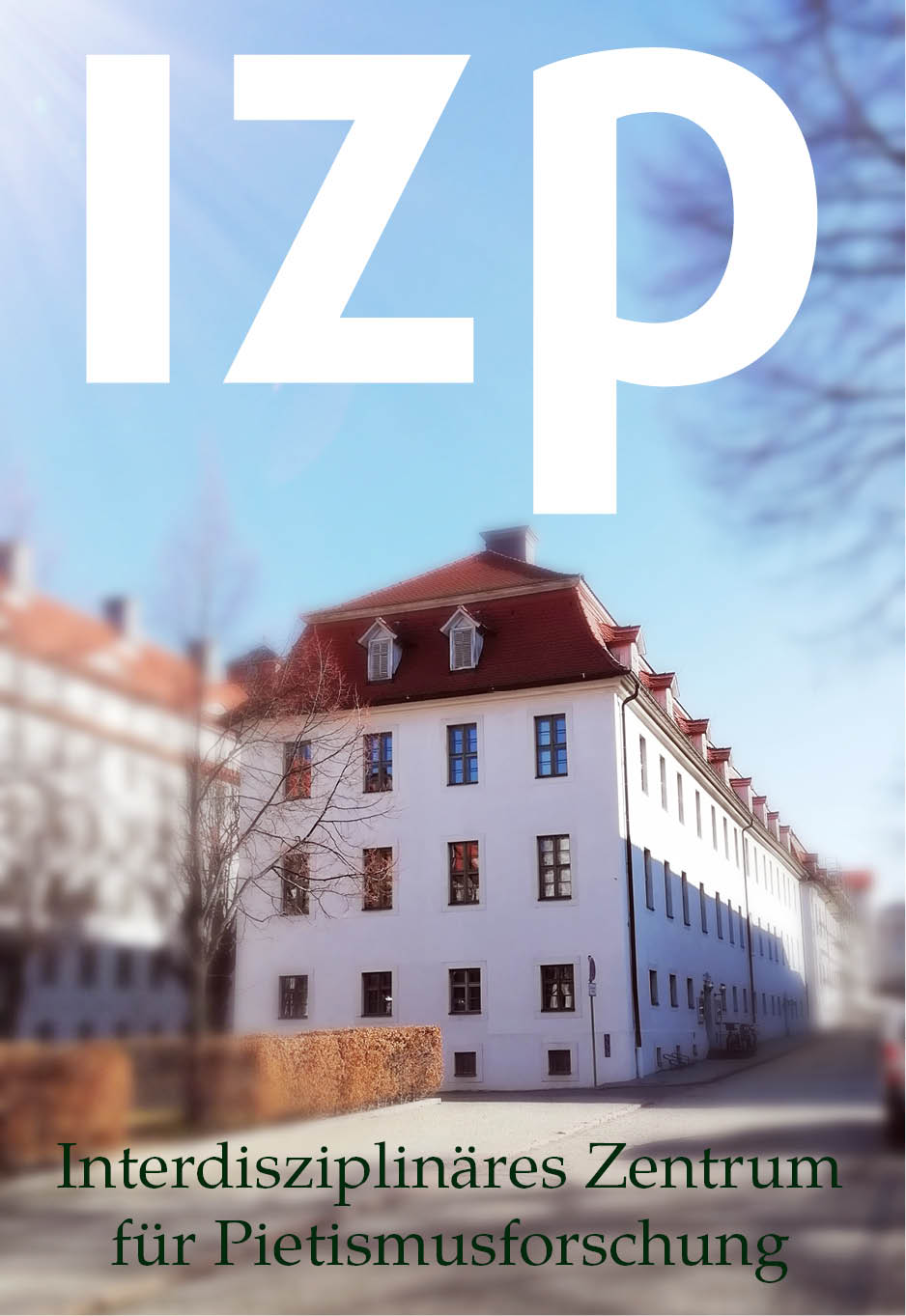
Interdisziplinäres Zentrum für Pietismusforschung
phone: +49 (0) 345 5523071
fax: +49 (0) 345 5527238
N. N.
Franckeplatz 1
Haus 24
06110 Halle
Ansprechpartnerin:
N. N.
postal address:
Interdisziplinäres Zentrum für Pietismusforschung
der Martin-Luther-Universität Halle-Wittenberg
06099 Halle

Interdisciplinary Centre for Pietism Research

Johann Albrecht Bengel: Erklärte Offenbarung Johannis (...), Stuttgart 1773, Frontispice
Who we are
The Interdisciplinary Centre for Pietism Research (IZP) at MLU is a unique institution dedicated to the study of Pietism and related currents of Christianity in the context of religious transformation processes from the early modern period to the present. Since its founding in 1993, the IZP has bridged the gap between university research and the Francke Foundations, which, as a significant institution for the history of Pietism, possess outstanding archives and collections. Beyond its own research projects, the IZP sees itself as an institution that has been networking researchers nationally and internationally for decades, raising awareness of their work – both via academic venues and through activities for a more general audience. This is achieved through conferences, lecture series, workshops, and mentoring for young researchers.
News & Events
Out now:
Ulrike Gleixner: Das Pietistische Empire. Expansive Frömmigkeit und Emotionspraktiken im Unterstützernetzwerk der Indienmission
Out now:
Tine R. Reeh / Catherine S. Beck (eds.): Dynamics of theology, medicine and law in early modern Nordic Lutheran societies
Out now:
Wolfgang Breul / Esther Kobel (Hg.): Aufbruch in Ruinen. Beiträge zur Geschichte der Evangelisch-Theologischen Fakultät Mainz
Conference:
Renewing Faith, Improving Society: A Comparison of Protestant Reform Movements in Prussia, England, and Georgia, 18th c.
Conference Oct. 12/13, 2026
FrSt_Wiss_Georgia-260903.pdf
(329.8 KB) vom 08.09.2026
CFP:
Protestant Mission Efforts towards Gypsy/Roma Communities (17th–21st Centuries)
2026 Annual Meeting of the Gypsy Lore Society and Conference on Romani Studies, Zagreb, Sept. 5-7, 2026
CFP GLS Protestant Roma Mission
CFP GLS Panel Roma Mission.pdf
(223.6 KB) vom 20.04.2026
Verkannte Verwandte? Pietismus und Kabbala
lecture series in winterterm 2026/27
organized by IZP and department for oriental studies at MLU
CFP:
Pietism and Rule
VII. International Congress for Pietism Research
Halle/Saale, September 5-8, 2027
CFP Pietismus und Herrschaft 2027
CFP Pietismus und Herrschaft 2027.pdf
(320.8 KB) vom 04.12.2025
CFP Pietism and Rule 2027
CFP Pietism and Rule 2027.pdf
(390.6 KB) vom 20.04.2026
Natural Science and Protestant Missionary Work - Blog
The plant collections of the Moravian Church in the herbarium of the Dresden University of Technology: identificationand contextualization using digital humanities methods
For more information, visit our blog
Dissertation honored
The prestigious award from the European Academy of Religion goes to Giovanni Tortoriello for his dissertation:
Scala Christus est. Reassessing the Historical Context of Martin Luther's Theology of the Cross, Tübingen: Mohr Siebeck 2023 (Spätmittelalter, Humanismus, Reformation, Band 135)
https://www.europeanacademyofreligion.org/it/alberigo-award